

I met Secret by chance. I call him “Secret” because his name sounds like the word “秘密” in Chinese.
We accidentally sat next to each other on a trip to Sun Moon Lake – a trip I had long planned to cancel due to the recent storms in Taiwan. For half the journey, he kept sleeping, sometimes fidgeting, sometimes breathing heavily, making me think he was suffering from severe motion sickness.
When I noticed him awake, gazing vacantly out the window, I asked, “Are you okay?”
This was my first spoken word in an hour of our journey. Secret seemed still dazed, taking a while to respond, “Ahhh, okay, okay.”
“Do you get car sickness?”
With his limited English, he replied, “No no no, I just… uhm… uhm… sleepy. Last night… uhm… I… 睡不夠 (did not sleep enough).”
Secret is quite talkative; he shared many stories from when he first arrived in Taiwan. My Chinese is basic, and his English is only at the level of “understanding a bit.”
So, he conversed in Chinese while I responded in English. It sounded weird, and indeed it was—though there seemed to be a language barrier, in truth, there was none.
The journey to Sun Moon Lake took about three hours. It was a lengthy ride, yet I found it enjoyable, as I could engage in conversation with Secret.
The scenery along the way was breathtaking. Our bus wound through twisting mountain roads, flanked by lush greenery. The sky was a clear blue, and the clouds were brilliantly white.
Taiwan, revitalized after the storm, appeared vibrant once more.
In the distance, I could see the lake, its waters crystal clear, reflecting the sky like a flawless mirror.
Nestled in the heart of Nantou County, Sun Moon Lake spans an impressive 7.73 square kilometers, making it one of Taiwan’s largest natural lakes. We arrived at Sun Moon Lake, pausing for a few moments to take photos before boarding a boat to explore the lake.

From afar, Sun Moon Lake is beautiful, but up close, it is a hundred times more stunning. The water is a vibrant blue, reminiscent of the sky and the ocean. I imagined that if viewed from above, it would resemble a jade gem hidden among the verdant foliage, or perhaps like the eyes of a dragon, clear yet profoundly deep.
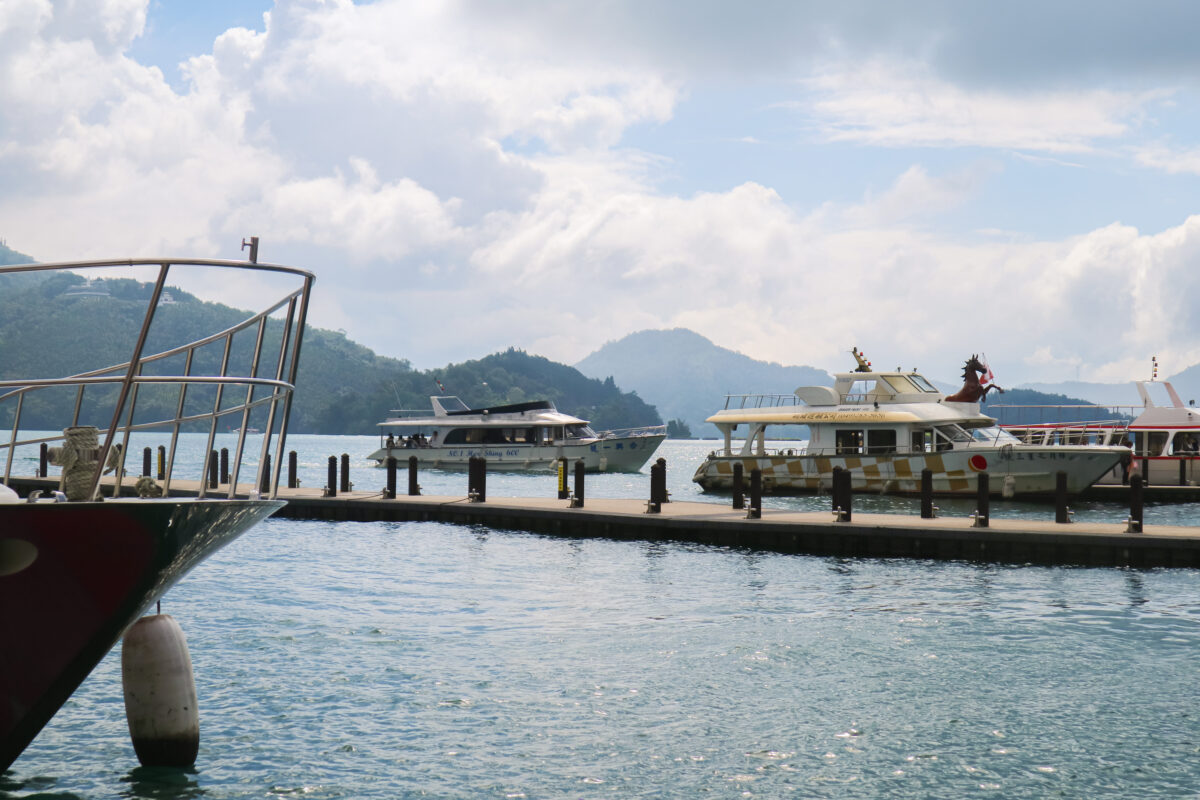
We sat on the boat, the gentle lapping of the water beneath us, the sun warming our skin – it was a scene straight out of a dream.
The sunlight was unexpectedly gentle, filtering through the leaves and glimmering upon the water’s surface. A soft breeze rippled the lake, creating a mesmerizing effect that compelled me to exclaim, “It’s beautiful!”
“Indeed,” Secret replied, pulling out his phone to capture the moment.
“It’s a pity that no camera can truly capture this beauty,” I lamented.
“可遠觀而不可褻玩焉,” he said.
“What does that mean?” I asked.
“It’s from the ‘Ai Lian Shuo,’ meaning: Beauty can only be appreciated from a distance, not toyed with.” He explained, his gaze still fixed on the stunning landscape outside the bus window.
Indeed, even from afar, we could feel the beauty of Sun Moon Lake – a beauty so profound it captivated us, making our eyes linger, wishing to cherish the moment forever.
This made me ponder: when we take out our phones or cameras to capture a beautiful moment in life, we know that no device can accurately record that beauty. If the photo turns out poorly, we might say, “My camera didn’t capture it well,” or “I didn’t take a good picture,” but we never blame the scenery for being unlovely.
Yet, when we photograph ourselves, we often shy away, saying, “I don’t look good.” It’s quite strange.